3D print cost calculator
Enter the grams and hours from your slicer and see the true cost of the print.
Waste, wear, labour and selling price
"It's only a few cents of plastic" is how most people price their first prints, and it is usually wrong. A print also uses electricity, wears out nozzles, belts and build plates, sometimes fails halfway, and takes your time to prepare and finish. This 3D print cost calculator puts all of that together. Type the filament weight and print time from your slicer, check the prices, and you get the real cost of the print, a cost per 100 grams and per print hour, and, if you sell, a selling price that covers markup and marketplace fees.
How to calculate the cost of a 3D print
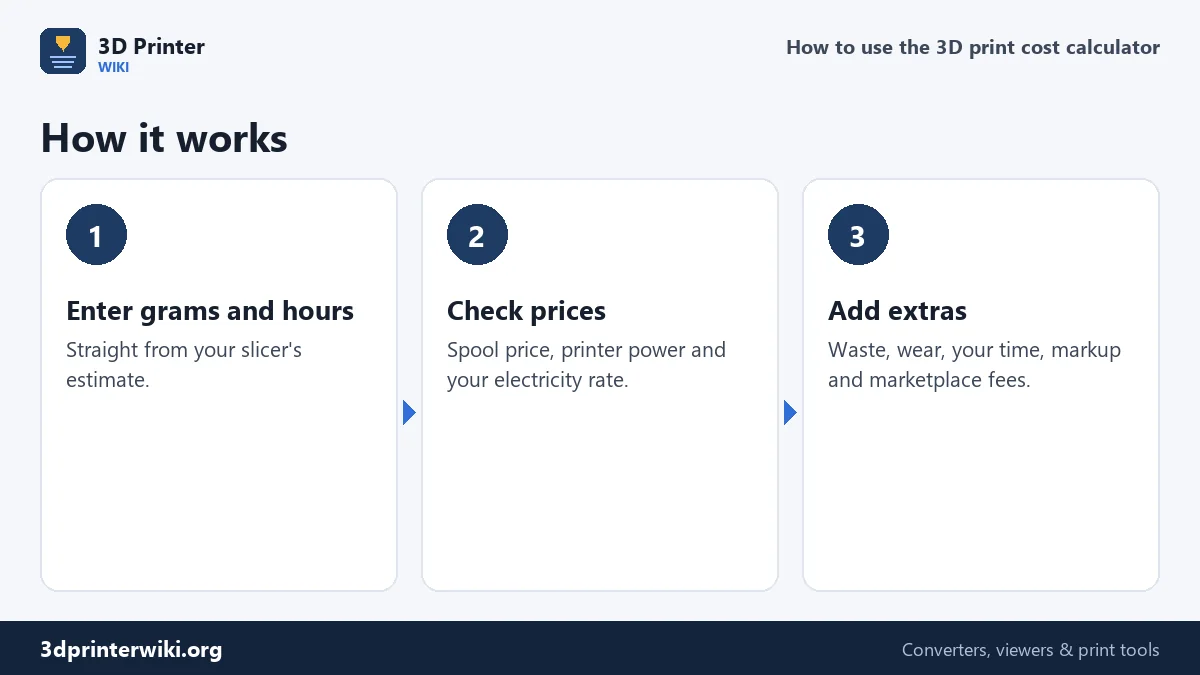
- Slice the model and note the filament weight in grams and the estimated print time.
- Enter grams and hours in the first two boxes.
- Check the prices: spool price per kilogram, your printer's average power and your electricity price per kWh. The defaults are typical values; change them to yours once and they are remembered on this device.
- Open "Waste, wear, labour and selling price" for the rest: a waste allowance, machine wear per hour, your own time and hourly rate, a markup and a marketplace fee.
How the cost is calculated
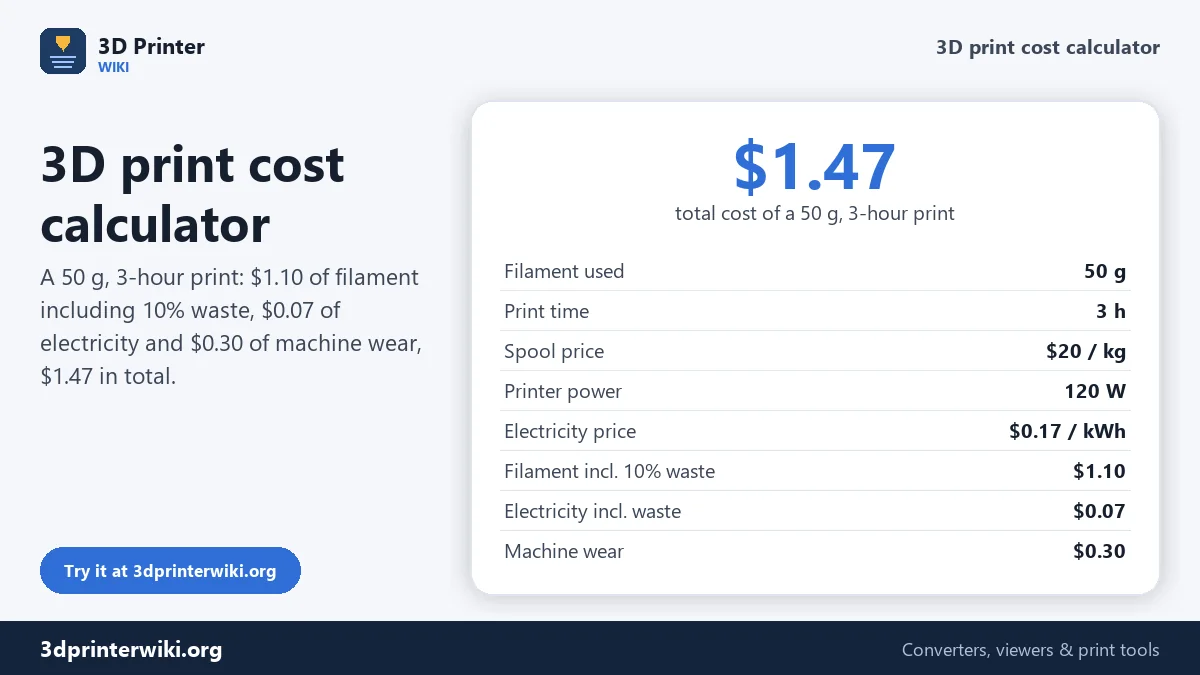
Filament = grams ÷ 1000 × spool price × (1 + waste). With the defaults, 50 g of $20/kg PLA plus a 10% waste allowance is $1.10.
Electricity = average watts × hours ÷ 1000 × price per kWh × (1 + waste). A printer averaging 120 W for 3 hours uses 0.36 kWh, about 6 cents at $0.17/kWh, plus waste.
Machine wear = wear rate × hours. Nozzles, PTFE tubes, belts, fans and build plates all wear out. Spread over their lifetime, they cost something like 5 to 20 cents per print hour on a hobby printer. The default is 10 cents.
Your time = hours of hands-on work × your hourly rate. This is preparation, slicing, removing supports, cleaning and packing; the printer's running time is not counted.
Selling price = total cost × (1 + markup) ÷ (1 − marketplace fee). Dividing by (1 − fee) makes sure that after the platform takes its cut, you still receive cost plus markup.
How much power does a 3D printer use?
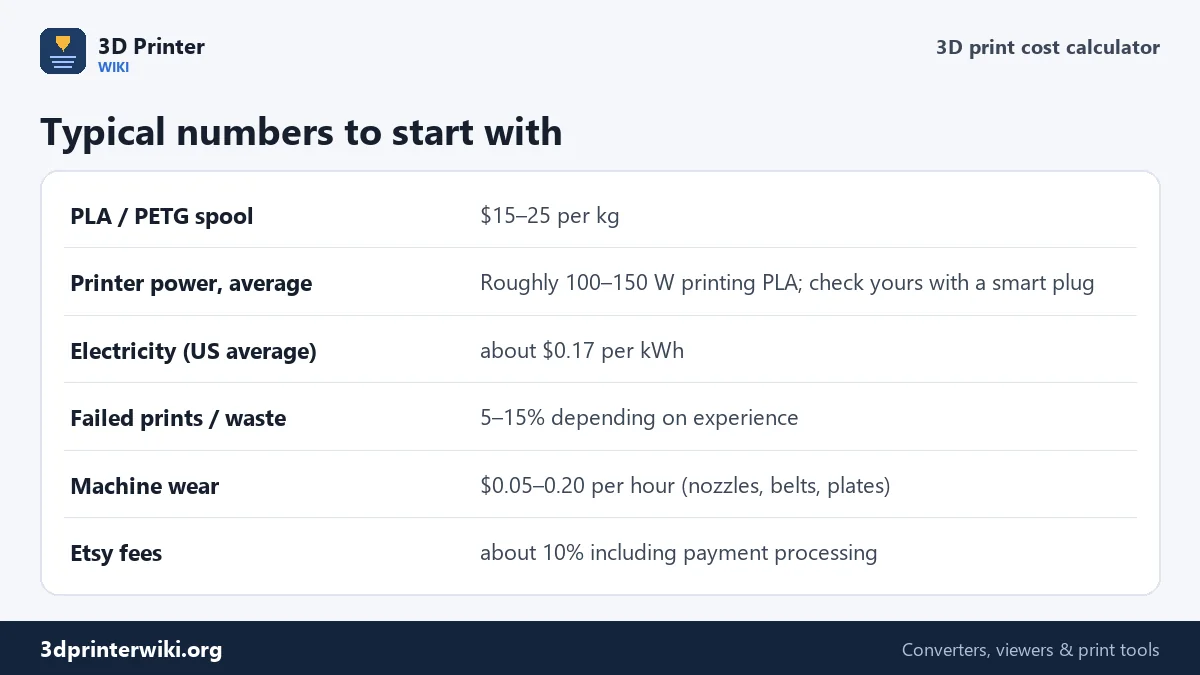
Less than most people expect, but more than zero. The heated bed draws the most at the start; once it is up to temperature, a typical bed-slinger or enclosed CoreXY printer averages roughly 100 to 150 watts while printing PLA, more with ABS in a heated chamber. A smart plug with energy monitoring tells you your printer's exact figure. Put that in the watts box for accurate numbers.
Pricing prints you sell
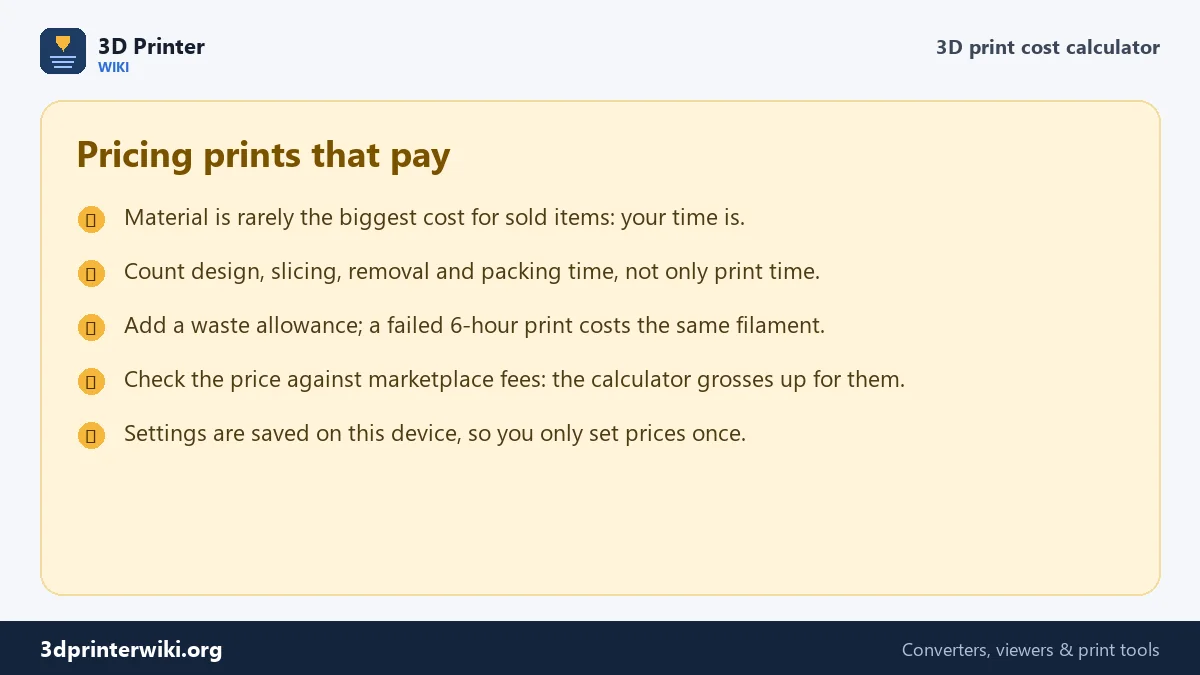
For most small items, the material and electricity are a small part of the price. A 20-gram keychain uses about 40 cents of filament. What decides whether you make money is time: designing or customising, slicing, removing it from the plate, cleaning, packing, posting and answering messages. Put a realistic number of hands-on hours into Your time and a fair hourly rate, and the calculator shows what the item really costs you. Then add a markup for profit and the marketplace fee (Etsy charges around 10% once transaction and payment fees are added together).
Don't know the grams yet?
Drop the STL into the STL volume calculator: it estimates the weight at your infill and shell settings, which you can paste in here. For filament length instead of weight, use the filament calculator.
A worked example
A phone stand weighs 50 g in the slicer and prints in 3 hours. With PLA at $20 per kg, a printer drawing 120 W on average and electricity at $0.17 per kWh, the material costs $1.00 and the 0.36 kWh of power about $0.06. The calculator's defaults then add 10% for failed prints and $0.10 per hour for machine wear, which brings the total to about $1.47.
That's the true cost of the print, not a sale price. To sell it, add your time: 10 minutes to start the job, remove the part and pack it is worth something at any hourly rate. Then add your markup and the marketplace fee. That's why fields for time, rate, markup and fees are there. Small, quick prints are dominated by your time; big, long prints by filament and machine hours.
Keep the defaults honest. If one print in five fails on your machine, the default 10% failure allowance is too low. If you print with expensive engineering filaments, nozzle and plate wear go up too.
3D print cost questions
How much does it cost to 3D print something?
For a typical 50 g PLA print taking 3 hours, about $1.50 in materials, electricity and wear. Your own time and selling fees come on top if you sell it.
How do you calculate the cost of a 3D print?
Filament cost (grams × price per gram) plus electricity (kWh × price) plus wear and waste. This calculator adds your time, markup and fees for a selling price.
How much electricity does a 3D printer use per hour?
Roughly 0.1 to 0.15 kWh per hour for PLA on common printers, so 2 to 3 cents an hour at US prices.
How should I price 3D prints to sell?
Start from the true cost here, add your hands-on time at a fair hourly rate, add a markup, and gross up for platform fees.
Does the calculator remember my prices?
Yes. Prices and rates are stored in your browser on this device, so they are filled in next time.
How much does a 50 g print cost?
About $1.00 in PLA at $20 per kg, plus about $0.06 of electricity for a 3-hour print. With the default allowances for failures and wear, around $1.47.
Should I include failed prints in the cost?
Yes. A small allowance covers the filament and time of prints that don't work out. Set it to match your own failure rate.
More 3D printing tools
Updated November 2026 · How these tools work