Resin print calculator
Work out the resin, the cost and the print time of a resin 3D print from its STL.
More options
Resin printers work differently from filament printers, and so does their cost and time. The resin used is basically the volume of the model plus its supports, and print time depends on how many layers there are, not on how much of the build plate is used. This resin print calculator reads an STL, works out the ml of resin it needs, solid or hollowed, the cost per print from your bottle price, and the print time from your layer height and exposure settings.
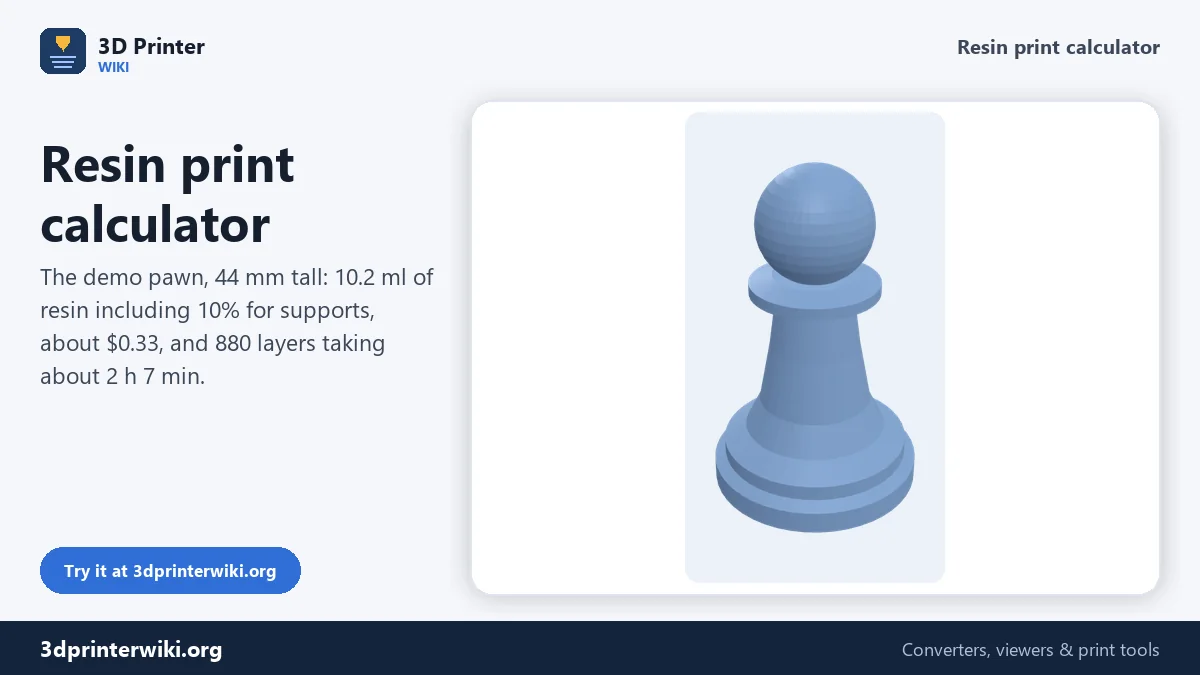
How to calculate a resin print
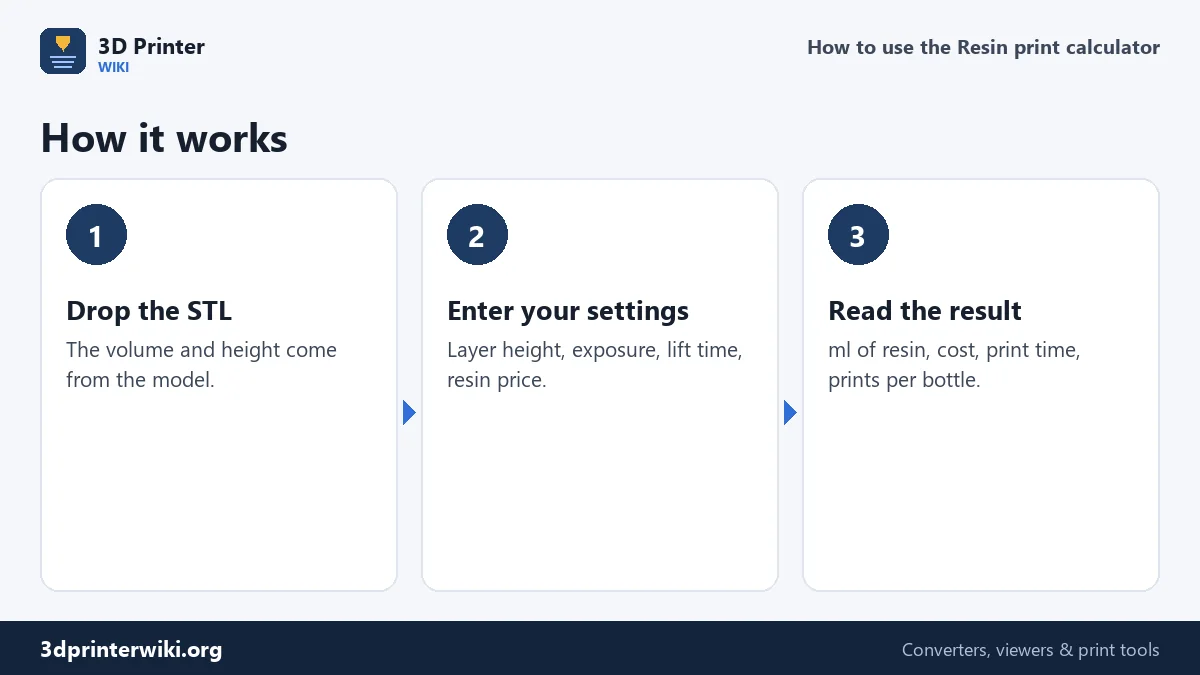
- Drop the model on the box. STL, 3MF, OBJ, PLY and STEP files work.
- Enter your print settings under More options: layer height, exposure time, bottom layers and bottom exposure, and the lift and retract time per layer.
- Enter your resin: the density from the bottle (about 1.1 g/ml for standard resin), the bottle price and size, and an allowance for supports and waste.
- Tick Hollow the model if you will hollow it in your slicer, and set the wall thickness.
- Read the results: resin in ml, cost, print time, weight and how many prints a bottle gives.
How much resin a print uses
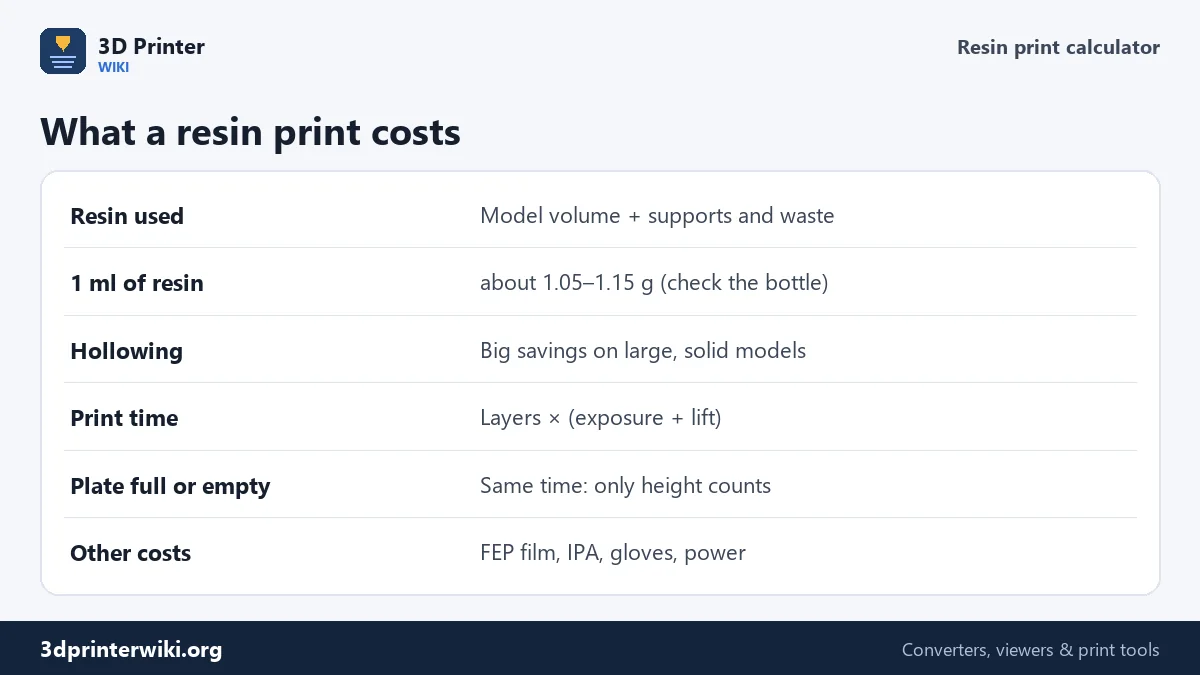
The starting point is the volume of the model: one cubic centimetre is one millilitre. The demo pawn is 9.23 cm³, so it needs 9.23 ml of resin before supports. Supports, rafts and the thin film left on the plate and in the vat add to that; 10% is a reasonable starting point for small models on light supports, while big models on heavy supports can need 20 to 30%. Resin is sold by weight, usually in 1 kg or 500 g bottles, so the calculator converts millilitres to grams with the density printed on the bottle. Standard resins are around 1.05 to 1.15 g/ml.
For the pawn with 10% extra, that's 10.2 ml or 11.2 g, about $0.33 from a $30 bottle of 1 kg, which is enough for about 89 pawns.
Hollowing
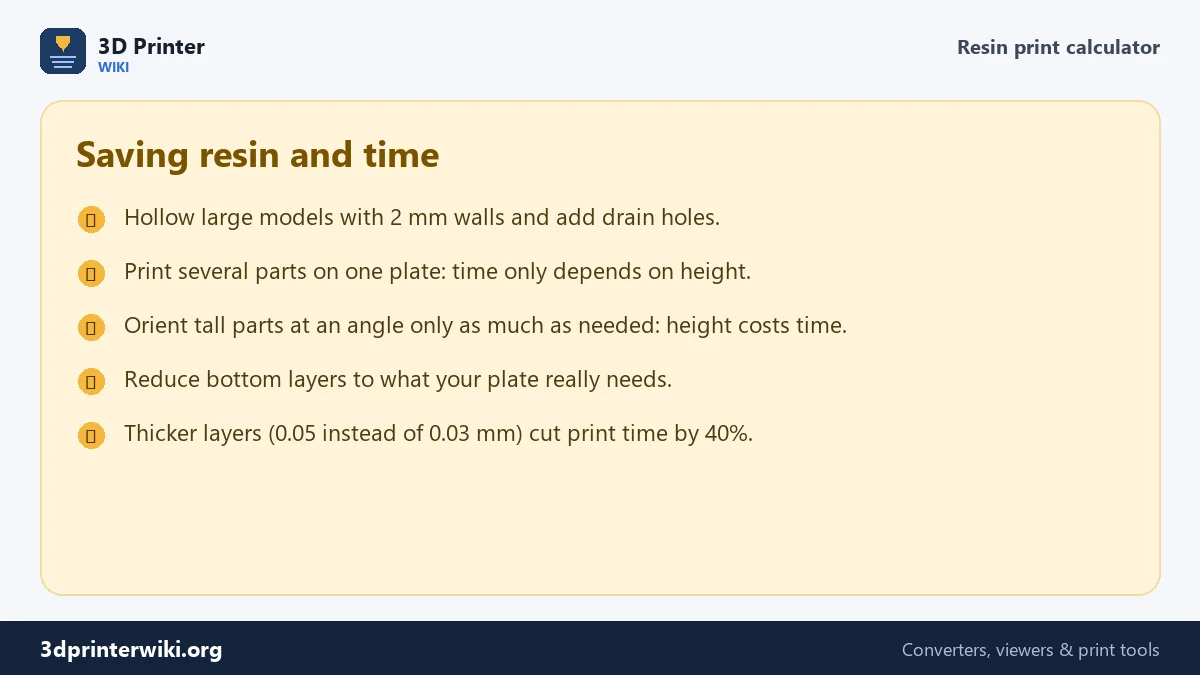
Big resin models are often hollowed: the slicer leaves a shell of 1.5 to 3 mm and empties the inside, with drain holes so uncured resin can run out. With Hollow the model ticked, the calculator estimates the resin as the surface area times the wall thickness. Small parts like the demo pawn save little, from 9.2 to about 6.6 ml before supports at 2 mm walls, because most of a small model is close to its surface. A solid 100 mm bust, on the other hand, can use several times less resin when hollowed. Always add drain holes, and wash and cure the inside too, or trapped resin can crack the print later.
How long a resin print takes
A resin printer exposes a whole layer at once, so a layer takes the same time whether it holds one small part or a full plate. Print time is therefore simply:
time = bottom layers × (bottom exposure + lift) + other layers × (exposure + lift)
The number of layers is the model's height divided by the layer height. The pawn is 44 mm tall: at 0.05 mm, that's 880 layers. With 5 bottom layers at 30 seconds, normal layers at 2.5 seconds and 6 seconds of lift and retract per layer, it takes about 2 hours 7 minutes. The lift and retract time is the one to check: it depends on your printer and the lift distance and speed in your profile, and on many printers it is longer than the exposure itself. Your slicer's time for one model is the best way to tune it.
Other costs
Resin is the main running cost, but not the only one. The FEP or nFEP film in the vat wears out after some hundreds of prints, isopropyl alcohol or a washing liquid is used up cleaning parts, and gloves and paper towels add a little. Power use of resin printers is small compared with filament printers with heated beds. For filament prints, use the 3D print cost calculator instead; for just the volume of a model, the STL volume calculator.
Resin print questions
How much resin does my STL need?
Its volume in cm³ is the resin in ml. Add about 10% for supports and waste; drop the STL here to calculate it.
How many prints do I get from 1 kg of resin?
About 900 ml at 1.1 g/ml, divided by the resin per print including supports. The calculator shows it for your model.
How long does a resin print take?
Number of layers times exposure plus lift time. A 44 mm tall model at 0.05 mm layers takes about two hours.
Does printing more parts at once take longer?
No. A resin printer exposes the whole layer at once, so only the height of the tallest part matters.
Should I hollow resin prints?
Large ones, yes, with 2 to 3 mm walls and drain holes. Small parts save little.
What is the density of resin?
Standard resins are about 1.05 to 1.15 g/ml. The exact value is usually printed on the bottle or data sheet.
Is resin printing cheaper than filament?
Per gram, resin costs more than most filament, but small detailed parts use very little of it. Large parts are usually cheaper in filament.
More 3D printing tools
Updated November 2026 · How these tools work